US Public Schools
U.S. · 101,110 locations
Every public school in the United States — 101,110 campuses for the 2024-25 school year, straight from the federal Common Core of Data.
More about this list
Street address, phone and map coordinates on every record and a school website on 68.8%, plus enrolment, enrolment by grade, by sex and by ethnicity, teacher count, student-teacher ratio, grade range, school level, district name and federal district ID, charter and virtual flags, free and reduced-price lunch counts and percentages, locale, metro area and congressional district. The 8,234 charter schools are included and flagged. No contact names — this is a list of schools, not of people. One row is one public school campus at its physical address — 101,110 of them, every school the federal directory lists as operating in the 2024-25 school year (101,110 records, less the 1,068 it marks closed). It is built from the National Center for Education Statistics' Common Core of Data for the 2024-25 school year — the public school directory and school characteristics files, the EDGE public school administrative data layer, and the EDGE public school geocode. US federal government data, public domain. Nothing in it was bought, licensed or taken from another company's product. Measured on every row of this file: a street address on 100.0%, a phone number on 100.0%, a website on 68.8%, map coordinates on 100.0%, enrolment on 98.1% and a teacher count on 95.1%. 88 columns in all, and the page lists the fill rate for each one. Compared with the published field list of PublicSchoolReview, the one vendor in this market that prints both its fields and its price: this file carries 16 of their 17 fields. The one it does not is School Rating and Testing Rank, a rating of their own that no federal source publishes. Title I and magnet status are not in the file because the federal school files for 2024-25 do not publish them.
The file has all 101,110 locations across 56 states in one download. Building the same list by searching one area at a time tends to miss places, and a missed place looks like a gap in coverage that is not really there.
Need just some of them? Ask in your own words.
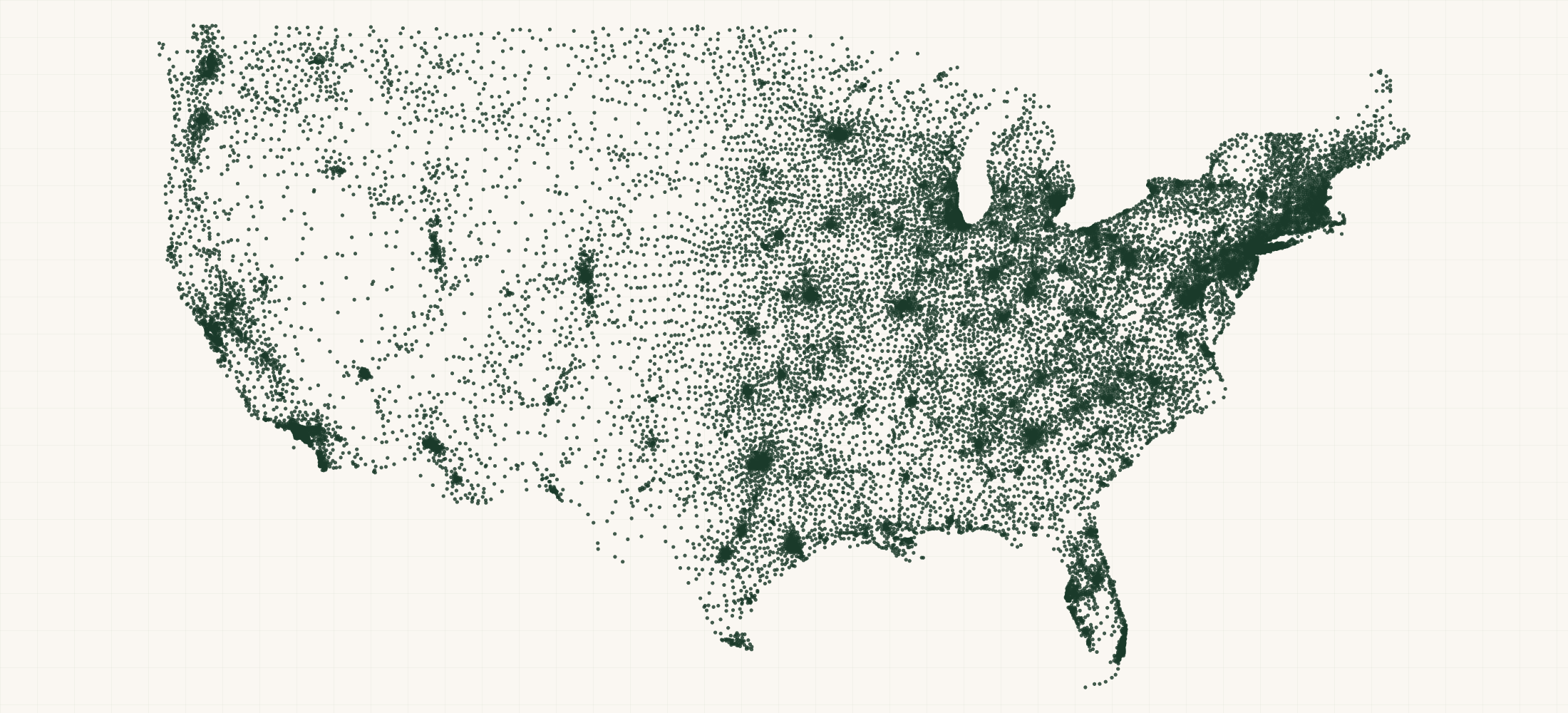
●Where the rows are
≡Sample Data Preview
| name | address | city | state | zip | phone | website | school type | affiliation | grade range | enrollment | teachers | county | nces id | lea id | state school id | lowest grade offered | highest grade offered | school level | school type detail | charter | virtual | shared time | lunch program | status | student teacher ratio | free reduced lunch | free lunch | reduced lunch | free lunch pct | reduced lunch pct | direct certification | enrollment pre K | enrollment kindergarten | enrollment grade1 | enrollment grade2 | enrollment grade3 | enrollment grade4 | enrollment grade5 | enrollment grade6 | enrollment grade7 | enrollment grade8 | enrollment grade9 | enrollment grade10 | enrollment grade11 | enrollment grade12 | enrollment grade13 | enrollment ungraded | enrollment adult ed | enrollment male | enrollment female | students american indian | students asian | students black | students hispanic | students pacific islander | students two or more | students white | students american indian male | students american indian female | students asian male | students asian female | students black male | students black female | students hispanic male | students hispanic female | students pacific islander male | students pacific islander female | students two or more male | students two or more female | students white male | students white female | locale | cbsa | cbsa name | csa | csa name | congressional district | state leg district lower | state leg district upper | reference year | geo precision | county fips | address quality | country | latitude | longitude | source url |
|---|---|---|---|---|---|---|---|---|---|---|---|---|---|---|---|---|---|---|---|---|---|---|---|---|---|---|---|---|---|---|---|---|---|---|---|---|---|---|---|---|---|---|---|---|---|---|---|---|---|---|---|---|---|---|---|---|---|---|---|---|---|---|---|---|---|---|---|---|---|---|---|---|---|---|---|---|---|---|---|---|---|---|---|---|---|---|---|
| Joann A. Alexie Memorial School | 101 Village Rd | Atmautluak | AK | 99559 | (907) 553-5112 | http://atmautluak.lksd.org/ | public | Lower Kuskokwim School District | PK-12 | 121 | 7 | Bethel Census Area | 020000100206 | 0200001 | AK-31-310030 | PK | 12 | Other | Regular School | No | Supplemental Virtual | No | Yes under Community Eligibility Option (CEO) | Open | 17.29 | 123 | 123 | 0 | 0 | 92 | 18 | 9 | 13 | 6 | 9 | 6 | 10 | 11 | 7 | 7 | 7 | 6 | 6 | 6 | 73 | 48 | 121 | 0 | 0 | 0 | 0 | 0 | 0 | 73 | 48 | 0 | 0 | 0 | 0 | 0 | 0 | 0 | 0 | 0 | 0 | 0 | 0 | Rural, Remote | 0200 | 02038 | 0200S | 2024-2025 | source | 02050 | complete | US | 60.857371 | -162.276467 | https://nces.ed.gov/ccd/files.asp | ||||||||
| Gardner-Newman Middle School | 101 S Shannon Dr | LaGrange | GA | 30241 | (706) 883-1535 | public | Troup County | 6-8 | 963 | 63.2 | Troup County | 130000100593 | 1300001 | GA-741-0191 | 6 | 8 | Middle | Regular School | No | Not Virtual | No | Yes under Community Eligibility Option (CEO) | Open | 15.24 | 949 | 949 | 0 | 98.5 | 0 | 392 | 316 | 318 | 329 | 501 | 462 | 0 | 29 | 443 | 158 | 1 | 45 | 287 | 0 | 0 | 19 | 10 | 234 | 209 | 76 | 82 | 1 | 0 | 20 | 25 | 151 | 136 | Town, Distant | 29300 | LaGrange, GA-AL | 122 | Atlanta--Athens-Clarke County--Sandy Springs, GA-AL | 1303 | 13136 | 13029 | 2024-2025 | source | 13285 | complete | US | 33.068221 | -84.984392 | https://nces.ed.gov/ccd/files.asp | |||||||||||||||
| Maya Angelou Academy at New Beginnings formerly Oak Hill | 8400 River Rd | Laurel | MD | 20724 | (202) 299-3227 | http://www.seeforever.org/ | public | DYRS | 7-12 | 45 | 9 | Anne Arundel County | 110008700213 | 1100087 | DC-4002-860 | 7 | 12 | High | Alternative Education School | No | Not Virtual | Yes participating without using any Provision or the CEO | Open | 4.56 | 25 | 0 | 0 | 17 | 18 | 5 | 1 | 4 | 37 | 4 | 0 | 0 | 38 | 3 | 0 | 0 | 0 | 0 | 0 | 0 | 0 | 34 | 4 | 3 | 0 | 0 | 0 | 0 | 0 | 0 | 0 | Rural, Fringe | 12580 | Baltimore-Columbia-Towson, MD | 548 | Washington-Baltimore-Arlington, DC-MD-VA-WV-PA | 2405 | 24021 | 24021 | 2024-2025 | source | 24003 | complete | US | 39.101153 | -76.787327 | https://nces.ed.gov/ccd/files.asp | ||||||||||||||||
| John Stark Regional High School | 618 N STARK HWY | Weare | NH | 03281 | (603) 529-7675 | http://www.jsrhs.net | public | John Stark Regional School District | 9-12 | 612 | 53.9 | Hillsborough County | 330000300500 | 3300003 | NH-275-26380 | 9 | 12 | High | Regular School | No | Not Virtual | No | Yes participating without using any Provision or the CEO | Open | 11.35 | 93 | 74 | 19 | 12.1 | 3.1 | 157 | 180 | 152 | 123 | 323 | 289 | 0 | 2 | 0 | 19 | 0 | 28 | 563 | 0 | 0 | 1 | 1 | 0 | 0 | 10 | 9 | 0 | 0 | 16 | 12 | 296 | 267 | Rural, Distant | 31700 | Manchester-Nashua, NH | 148 | Boston-Worcester-Providence, MA-RI-NH | 3302 | 33528 | 33008 | 2024-2025 | source | 33011 | complete | US | 43.127458 | -71.758368 | https://nces.ed.gov/ccd/files.asp | ||||||||||||||
| Lee High | 990 Wisacky Highway | Bishopville | SC | 29010 | (803) 896-2531 | public | Dept Of Correction N04 | 9-12 | 5 | 4 | Lee County | 450000100063 | 4500001 | SC-5209-021 | 9 | 12 | High | Alternative Education School | No | Supplemental Virtual | No | Yes participating without using any Provision or the CEO | Open | 1.25 | 0 | 2 | 1 | 2 | 5 | 0 | 0 | 0 | 5 | 0 | 0 | 0 | 0 | 0 | 0 | 0 | 0 | 5 | 0 | 0 | 0 | 0 | 0 | 0 | 0 | 0 | 0 | Rural, Distant | 4505 | 45050 | 45029 | 2024-2025 | source | 45061 | complete | US | 34.197587 | -80.226312 | https://nces.ed.gov/ccd/files.asp |
{}What's in each row
| Field | What it is | Rows filled |
|---|---|---|
| name | The school's official name as published in the federal school directory. | 100% |
| school | Always "public" — the kind of school, matching the same column on our private and charter school lists so the three stack. | 100% |
| affiliation | The school district (local education agency) the school belongs to, by name. | 100% |
| grade | The grades the school offers, lowest to highest, such as PK-5 or 9-12; PK is pre-kindergarten and KG kindergarten. Blank where the school offers no grades or did not report them. | 98% |
| enrollment | Total students enrolled, as a count; blank where the school did not report, never a guessed zero. | 98% |
| teachers | Classroom teachers as full-time equivalents, so 43.5 is possible. | 95% |
| address | The street address of the school campus — its physical location, not a mailing address. | 100% |
| city | The city of the campus, corrected during cleanup to the Census spelling for its postcode. | 100% |
| state | The two-letter state or territory code. | 100% |
| zip | The five-digit postcode of the campus, kept as text so a leading zero survives. | 100% |
| country | United States on every row. | 100% |
| phone | The school's main telephone number from the federal directory. | 100% |
| website | The school's own website as reported to the federal directory, on 68.8% of rows; blank means it reported none. | 69% |
| latitude | Latitude of the campus in decimal degrees — the federal government's own geocode of the street address. | 100% |
| longitude | Longitude of the campus in decimal degrees — the federal government's own geocode of the street address. | 100% |
| county | The county the campus is in. | 100% |
| source | The federal page this record comes from, so every row carries its citation. | 100% |
| nces | The 12-digit federal school ID, kept as text so the leading zero survives; the key to every other federal school file. | 100% |
| lea | The 7-digit federal ID of the school's district — the same ID on our US School Districts list. | 100% |
| state | The ID the school's own state uses for it. | 100% |
| lowest | The lowest grade offered: PK, KG, 1 to 13, UG for ungraded or AE for adult education. | 98% |
| highest | The highest grade offered, on the same scale. | 98% |
| school | The federal school level — Elementary, Middle, High, Secondary, Prekindergarten, Adult Education, Ungraded, Other or Not Applicable. "High schools only" is one filter on this column. | 99% |
| school | Regular, special education, career and technical, or alternative education school. | 100% |
| charter | Yes for a charter school, No for a regular public school, Not applicable in a state with no charter law. | 100% |
| virtual | Whether instruction is virtual: Not Virtual, Supplemental Virtual, Full Virtual, or Virtual with face to face options. | 89% |
| shared | Yes when the school serves students who spend part of the day at another school (often career and technical centres). | 74% |
| lunch | Whether and how the school takes part in the National School Lunch Program, including the Community Eligibility Provision under which every student eats free. | 96% |
| status | The school's status that year: Open, New, Inactive, Future, Added, Reopened or Changed Boundary/Agency. | 100% |
| student | Students per full-time-equivalent teacher, as published. | 93% |
| free | Students eligible for free or reduced-price lunch, as a count. | 80% |
| free | Students eligible for free lunch, as a count. | 74% |
| reduced | Students eligible for reduced-price lunch, as a count. | 74% |
| free | Free-lunch eligible students as a percentage of enrolment, to one decimal; blank where either figure is missing or the count exceeds enrolment. | 74% |
| reduced | Reduced-price-lunch eligible students as a percentage of enrolment, to one decimal. | 74% |
| direct | Students directly certified for free meals through other assistance programmes, as a count. | 49% |
| enrollment | Students in pre-kindergarten; blank where the school does not offer it. | 34% |
| enrollment | Students in kindergarten; blank where the school does not offer it. | 53% |
| enrollment | Students in grade 1; blank where the school does not offer it. | 54% |
| enrollment | Students in grade 2; blank where the school does not offer it. | 54% |
| enrollment | Students in grade 3; blank where the school does not offer it. | 54% |
| enrollment | Students in grade 4; blank where the school does not offer it. | 53% |
| enrollment | Students in grade 5; blank where the school does not offer it. | 52% |
| enrollment | Students in grade 6; blank where the school does not offer it. | 37% |
| enrollment | Students in grade 7; blank where the school does not offer it. | 33% |
| enrollment | Students in grade 8; blank where the school does not offer it. | 33% |
| enrollment | Students in grade 9; blank where the school does not offer it. | 28% |
| enrollment | Students in grade 10; blank where the school does not offer it. | 28% |
| enrollment | Students in grade 11; blank where the school does not offer it. | 28% |
| enrollment | Students in grade 12; blank where the school does not offer it. | 28% |
| enrollment | Students the school reports as ungraded. | 5% |
| enrollment | Students reported as male, as a count. | 98% |
| enrollment | Students reported as female, as a count. | 98% |
| students | Students reported as American Indian or Alaska Native, as a count; a real zero stays zero. | 98% |
| students | Students reported as Asian, as a count; a real zero stays zero. | 98% |
| students | Students reported as Black or African American, as a count; a real zero stays zero. | 98% |
| students | Students reported as Hispanic or Latino, as a count; a real zero stays zero. | 98% |
| students | Students reported as Native Hawaiian or other Pacific Islander, as a count; a real zero stays zero. | 98% |
| students | Students reported as two or more races, as a count; a real zero stays zero. | 98% |
| students | Students reported as White, as a count; a real zero stays zero. | 98% |
| students | Male students reported as American Indian or Alaska Native, as a count. | 98% |
| students | Female students reported as American Indian or Alaska Native, as a count. | 98% |
| students | Male students reported as Asian, as a count. | 98% |
| students | Female students reported as Asian, as a count. | 98% |
| students | Male students reported as Black or African American, as a count. | 98% |
| students | Female students reported as Black or African American, as a count. | 98% |
| students | Male students reported as Hispanic or Latino, as a count. | 98% |
| students | Female students reported as Hispanic or Latino, as a count. | 98% |
| students | Male students reported as Native Hawaiian or other Pacific Islander, as a count. | 98% |
| students | Female students reported as Native Hawaiian or other Pacific Islander, as a count. | 98% |
| students | Male students reported as two or more races, as a count. | 98% |
| students | Female students reported as two or more races, as a count. | 98% |
| students | Male students reported as White, as a count. | 98% |
| students | Female students reported as White, as a count. | 98% |
| locale | How urban or rural the campus is, on the federal 12-step scale from City, Large to Rural, Remote. | 100% |
| cbsa | Federal code of the metropolitan or micropolitan area the campus is in; blank where it is in none. | 89% |
| cbsa | Name of that metropolitan or micropolitan area. | 89% |
| csa | Federal code of the combined statistical area the campus is in; blank where it is in none. | 73% |
| csa | Name of that combined statistical area. | 73% |
| congressional | The congressional district: the two-digit state code followed by the two-digit district number. | 100% |
| state | The state legislative district, lower chamber, as the state code followed by the district number. | 99% |
| state | The state legislative district, upper chamber, as the state code followed by the district number. | 100% |
| reference | The school year every figure describes — 2024-2025 on every row. | 100% |
| geo_ | How the coordinates were arrived at: source where the federal geocode was kept, address or zip centroid on the few rows whose point was re-placed during cleanup. | 100% |
| county_ | The five-digit federal county code, set during cleanup from the campus coordinates. | 100% |
| address_ | How usable the street address is: complete, no house number or po box. | 100% |
Rows filled is measured on every row of the delivered file.
✓Where this data comes from
This dataset is built from the federal Common Core of Data for the 2024-25 school year: the NCES EDGE public school administrative layer, which carries every operating campus with its location address, enrolment by grade, sex and ethnicity, staffing, lunch eligibility and the government's own geocode, joined on the school's 12-digit federal ID to the CCD school directory file (website and state school ID), the CCD school characteristics file (shared-time, virtual and lunch programme status) and the NCES EDGE public school geocode (metro area, congressional and state legislative districts). Nothing is taken from a school's own website and nothing from a licensed third-party product. Title I and magnet status are not included: the 2024-25 federal school files do not publish them.
October 7, 2026
File built
88 fields
Columns in the file
Fill measured
On every row of the delivered file
Schools are published as the federal collection holds them. Counts the source did not report are left empty rather than set to zero, the source's placeholder codes are blanked, city spellings are corrected to the Census place name for their postcode, map points that fell outside their own state are re-placed, and every row carries the county, a coordinate-precision flag and an address-quality flag. Each build is reconciled against the live federal count and the federal directory, and a random sample is checked against the live government data before it is published. There are no personal names, job titles or email addresses.
How we build and date every file: methodology.
Using ChatGPT, Claude or an API?
No setup needed. Ask ChatGPT or Claude your question about the US Public Schools and give it this page: it can open https://locationlists.com/find?dataset=public-school-list with the filters you need and show you the count and price.
Using ChatGPT or Claude? Tell it to answer from locationlists.com/find — no account, no connector.
How assistants ask
No connector needed. Any AI assistant can answer from this site with a web link, no connector, no account: open https://locationlists.com/find with the question as query parameters.
If a question needs filtering, distance, drive time, combining lists or a price, open a /find link: either put the question itself in q=, or build the structured link. The answer does not need an API, a connector or an account.
Simplest, the question itself: https://locationlists.com/find?q=<the question in plain words>
Or set the parts yourself: https://locationlists.com/find?dataset=<slug>&state=<ST>&city=<city>&county=<county>&zip=<zip>&near=<place or zip>&radius=<miles>&drive=<minutes>&where=<column>:<op>:<value>&total=<rows>
Leave out what the question does not need. Use radius for straight-line miles or drive for minutes of driving (5 to 60), not both; near can name several places separated by | to reach from any of them. To ask about several lists at once, use datasets with two or more names, or category with a kind of business. To compare two lists, add relate=nearest and the other list with b. in front of its parameters. To count by area, use areas=county (or zip, state, metro). To keep only places whose county, ZIP code, metro area or state meets a Census figure, add area_where (for example county:population>1000000); with areas, per=100000 gives counts per 100,000 residents.
Links an assistant can open, each showing how many rows match, a few preview rows and the price for just that part:
- Only California, the state with the most: https://locationlists.com/find?dataset=public-school-list&state=CA
- Within 25 miles of New York, NY, the busiest area: https://locationlists.com/find?dataset=public-school-list&near=New+York+NY&radius=25
- Within a 30-minute drive of New York, NY: https://locationlists.com/find?dataset=public-school-list&near=New+York+NY&drive=30
- Only rows where enrollment is over 121: https://locationlists.com/find?dataset=public-school-list&where=enrollment%3Agt%3A121
- Every K-12 Schools list combined, within 25 miles of New York, NY: https://locationlists.com/find?category=k12-schools&near=New+York+NY&radius=25
- Each one's nearest US Private Schools, in California, with miles: https://locationlists.com/find?dataset=public-school-list&state=CA&relate=nearest&k=1&b.dataset=private-school-list&b.state=CA
- The whole list: add a city, state, ZIP code or distance:
https://locationlists.com/find?dataset=public-school-list - In plain words: "US Public Schools in California": https://locationlists.com/find?q=US+Public+Schools+in+California
- In plain words: "US Public Schools within 25 miles of New York, NY": https://locationlists.com/find?q=US+Public+Schools+within+25+miles+of+New+York%2C+NY
Optional: connect for repeat use or wallet payments:
Read https://locationlists.com/skill.md and follow the instructions to connect LocationLists. Then show me the US Public Schools list.Your assistant will walk you through setup and show you the price before you pay.
For developers
Every step below has a no-connector equivalent: https://locationlists.com/find?dataset=public-school-list with the same filters as query parameters.
- Connect your agent to
https://locationlists.com/mcp(no key, no signup). - Call
count_locationswithdataset: "public-school-list"and any filter — it is free, and returns how many rows match and what they cost. - Fetch the rows with
query_locations: $0.30 per 100 rows from this dataset. Above 50,555 rows, buying the whole file is cheaper.
Paid in USDC over x402 — the agent gets an HTTP 402 with the exact price, signs, and retries. Money moves only after rows are delivered, so a failed or empty query costs nothing. Setup for Claude, Cursor and VS Code
?Frequently Asked Questions
What is one row?
One public school campus, located at its physical street address — not its mailing address and not its district office. The map coordinates are the federal government's own geocode of that address, which is what a radius or drive-time filter needs.
Why 101,110, and not the figure I have seen elsewhere?
The federal school directory for 2024-25 holds 101,110 records. 1,068 of them are schools the directory itself marks as closed for the year; they are left out, and what remains — 101,110 — is every public school operating that year. Every row carries a status column, so the 872 new schools, the 372 that were due to open and the 501 that were temporarily inactive can be kept or dropped with one filter.
Are charter schools included?
Yes. 8,234 rows are charter schools, flagged Yes in the charter column — exactly the same schools, by federal school ID, as our US Charter Schools list, so there is no need to buy both. 3,707 schools are in states with no charter law and read "Not applicable".
How complete are the contact details?
Street address, city, state, postcode and map coordinates on every row. A phone number on 100.0%. A school website on 68.8% — the website is what the school reported to the federal directory, and a blank means it reported none.
Can I count students in particular grades?
Yes. Enrolment is broken out by grade, from pre-kindergarten to grade 13, plus ungraded and adult education, so "how many 9th to 12th graders are within 20 miles" is a sum of four columns. A blank grade means the school does not offer that grade or did not report it — never zero students.
How are the free-lunch percentages worked out?
The federal file publishes counts: students eligible for free lunch, for reduced-price lunch, and the two together. We ship the counts and divide each by the school's enrolment for the two percentage columns, to one decimal place. Where a count was not reported, or where the free-lunch count is larger than enrolment (344 schools, an inconsistency in what the state reported), the percentage is left blank rather than shown above 100. The lunch programme column says when a school serves every student free under the Community Eligibility Provision, which is why some schools show very high eligibility.
Can I cut it by metro area or congressional district?
Yes. Every school carries the federal code and name of the metropolitan or micropolitan area it sits in, the combined statistical area, its congressional district and both state legislative districts, from the government's own school geocode. A blank metro means the school is in no metro area at all — 11,128 schools are.
What was cleaned up before you sold it?
Before selling it, we unified 1,548 city names that were written more than one way inside the same postcode, corrected 78 misspelled city names, standardised the capitalisation on 39,130 more, re-placed 7 map points that fell outside their own state, and kept 99 schools that share a name and an address with another but have their own federal school ID — separate schools on one campus, which a plain duplicate check would have deleted. Every row also carries an address quality flag (complete, missing house number, or PO box) and a coordinate quality flag.
Why are some cells empty?
Because the federal source says so, and an empty cell is easier to work with than a code you have to decode. The source writes the letter N for "not applicable", M for "missing" and -1, -2 or -9 for counts that were not reported or not applicable; all of those are empty here. An empty count means not reported, never none: a real zero stays a zero. In this build we replaced 119,682 such codes across 10 text columns with empty cells, so a completeness figure means what it says.
Can I match this to the school districts?
Yes. Every row carries its federal district ID (leaId), the same ID on every row of our US School Districts list, so the two join directly with no name matching.
How often is it updated?
File built on October 7, 2026. It is not on an automatic refresh schedule, so check the build date above before you buy.
Where exactly does it come from?
All of it is United States federal government data, in the public domain: the National Center for Education Statistics' Common Core of Data for the 2024-25 school year — the public school directory and school characteristics files, the EDGE public school administrative data layer, and the EDGE public school geocode. Nothing in the file was bought, licensed or taken from another company's product. Before publishing we checked 25 randomly chosen schools against the government's live data and an independent copy of the same collection and found 0 disagreements.
Does this include the principal's or athletic director's name or email?
No. There are no personal names, job titles or email addresses anywhere in this file. The federal school collection does not publish any person at school level, and we do not guess names or invent email patterns. If you need a named contact you will need a contact database on top of this — which is why this file costs a fraction of one.
Does it include Title I or magnet school status?
No. The federal school files for 2024-25 do not publish a Title I field or a magnet field — we checked every one of the five school-level files the government releases. We left both columns out rather than fill them from another source or another year. The free and reduced-price lunch counts and the lunch programme column are the current federal measures of a school's need.
Does it include test scores, ratings or rankings?
No. Test results are published state by state, not in the federal school collection, and school ratings are other companies' own scores. Nothing in this file is a rating.
Does it include private schools?
No. This is every public school, charter schools included. Private schools are collected by a separate federal survey and sold as their own list, US Private Schools. The two never overlap, so they can be stacked without removing duplicates.